

While most cultivation companies specialize in specific varieties, Danish nursery Lundager has chosen a completely different path. This nursery for green mini-plants does not focus on growing only Alocasia or Calathea, for example, but instead on growing plants in a pot with a specific diameter.
“We are strong in growing and marketing plants in six-centimeter pots. And of those, we have around 500 different species and varieties. Why specialize in that? Very simple: All six-centimeter pots can stand on the same shelf in garden centers,” begins CEO Ove Lundager when we visited their nursery in Odense, Denmark.
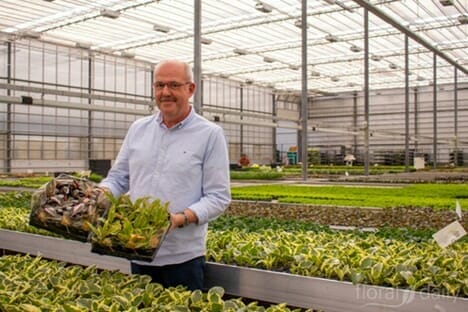
Ove Lundager in the greenhouse with Philodendron Pink Princess Marble (left) and Philodendron Ring of Fire (right). Click here to see the photo report from our visit to the nursery.
What started in 1985 as a nursery/garden center in Jutland was moved to Odense in 2004, closer to the export companies, and began to focus exclusively on horticultural operations. Today, the company has seven cultivation sites with a total of 12 hectares of greenhouses. Although the majority of production consists of plants in or to 6 cm pots (up to 20 million units per year), there is also a greenhouse where plants are grown in 10.5, 12 and 15 cm pots (four million units annually). There are two locations for mini-greens, three locations dedicated exclusively to Peperomia, as well as a smaller production unit for cacti and succulents.
Germany is the largest market
Customers all over Europe – retailers and garden centers – can find the complete range of mini green plants at the nursery. Only 13% of sales are in Denmark. Germany is the largest market, followed by France, Sweden and Poland. Many products are sent to Dutch companies, although the Netherlands is often not the final destination. The company even has a subsidiary there, Lundager BV, with two sales representatives.
Ove says that the small houseplants are sold all year round, although the first three months of the year and May are the peak season. “I think that after the Christmas plants, people want more greenery in their homes. Sales are lowest in summer and fall, but there is only a 25% difference between January and July. So we have work for all our 160 employees all year round. And in the summer they can take a well-deserved vacation without causing problems for the company because it’s less busy. So it works well.”
According to Ove, a stable workforce is important given the wide product range. “Experience is crucial. We have so many different products that it takes time – up to six months – to learn all the products in a greenhouse and master the cultivation processes. However, not everyone needs to know all 500 varieties. After all, we have seven locations, each with their own cultivation program.”
Competitive advantage
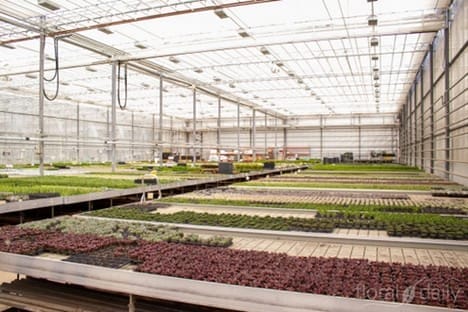
Every week, 500,000 plants leave the nursery, creating space for just as many new plants. “We have 12 hectares under glass and 250 plants fit on one square meter. That’s a lot, so there’s a significant inventory investment. This scale is perhaps our biggest advantage over the competition. Most plants take three to six months to grow, but some stay in our greenhouse for up to a year, like cacti. We usually buy them from Italy already a year old. We also occasionally get ‘semi-finished’ products from Poland and finished products from Thailand, but in negligible quantities,” Ove explains.
Although labor costs make Denmark less competitive than nurseries in southern Europe – as planting and even packing is still mostly done manually in the nursery – Ove says the company has some other advantages besides its size. “Last year we were able to produce cheaper with surplus heat from a power plant than companies that rely on gas. I would also definitely consider our efficient logistics an advantage. That’s why it’s interesting to consider establishing a production facility in the Netherlands.”
“We would be much closer to the exporters we work with, which would eliminate a logistical cost. But we and many of our employees have many years of experience here and know exactly how we work in the Danish climate. It’s not easy to just set up a new nursery and start doing the same thing in another country. And of course, with our extensive range – which we occasionally expand with new varieties – we have a competitive advantage in the market,” says Ove Lundager.
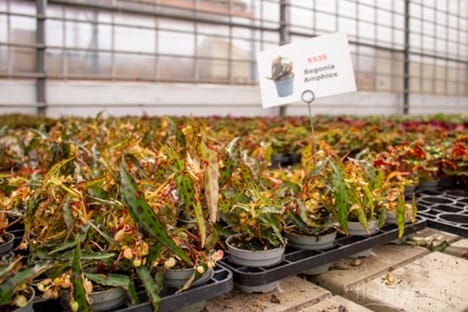
Begonia Amphioxus
Own varieties
The new varieties come either from the company’s breeding program or external breeders. It is interesting for them to work with this Danish nursery, given its position in the market. “Breeding is a long-term effort, but having our own varieties is important because then we can come out with something unique. We sell licenses for our own protected varieties to growers all over the world.”
“Around five to ten percent of the trial plants eventually end up in the assortment,” adds Sales Director Rasmus Dupont Larsen. “But it can’t get much bigger. It’s already quite complex, also when it comes to packaging, and we don’t want customers to be confused by a myriad of varieties. Of course, garden centers also have other suppliers, and in the long run it often becomes too much. Our best-selling plants are Calathea, Alocasia, Philodendron and Peperomia. We are developing some new varieties that could soon make a difference.”
'TINGDAL by LUNDAGER'
The company’s focus has only recently shifted to Peperomia in larger pots, especially after the company took over the part of Tingdal – another Danish nursery – that focuses on breeding and propagating this plant species in September last year. “We even kept part of the brand name because it was very well known in the industry. Now it’s ‘TINGDAL by LUNDAGER’. It reflects both the past and the future in a nice way,” says Rasmus.

Peperomia
Pots
Half of the plants are sent in pots to buyers, the other half are not. “Or we deliver one cart with plants and another with pots; that happens too. Then the customers can choose the right pots for the plants themselves. The pots are designed by Oliver Lundager and are produced in China and Portugal. Several qualities are available, depending on customer requirements and preferences. We supply both plastic and ceramic pots.”
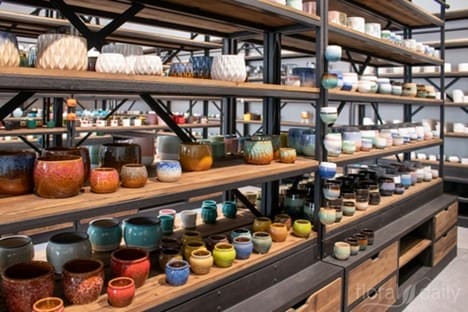
Rows of ceramics
Even greener
Today, buyers value not only quality, service and aesthetics, but increasingly also the sustainability of the production process. “And rightly so,” Ove continues. “We also find it essential. We no longer use pesticides and try to grow the plants as organically as possible. Our CO2 emissions have already decreased significantly with new screens and glass and by buying green energy from wind turbines. We will do even more in the future. For example, we could install more solar panels on the greenhouse roofs. This would immediately make us more energy independent. In this area, I see that we are ahead of many others in the industry. However, we need to inform consumers more and better about this. Ultimately, it’s also a marketing strategy.”
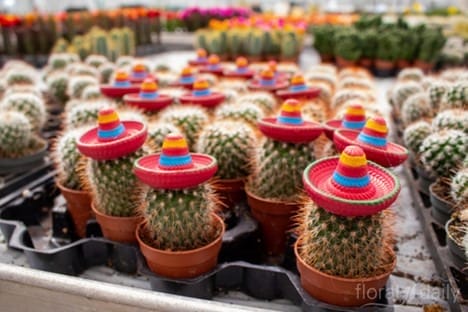
Mini green plants
According to Ove, the company’s mini green plants have a bright future. “Green plants are becoming more and more popular, even among young people. And many consumers want something special. There are even people who will pay 1,000 euros for a specialty variety. So we will definitely invest more in our already extensive business. We are considering modernizing outdated greenhouses with high energy costs and expanding the greenhouse area by two to three hectares. We want to increase turnover not only by selling larger volumes, but also by improving our customer service, for example with new varieties and a new ceramic range,” Ove concludes.
For more information:
Ove Lundager (CEO and owner)
LUNDAGER
33 Fangelvej, 5260, Odense, Denmark
Tel: +45 659 61 735
Email: ove@75012.dk
www.lundagerplants.com
Author: Elita Vellekoop
© FloralDaily.com